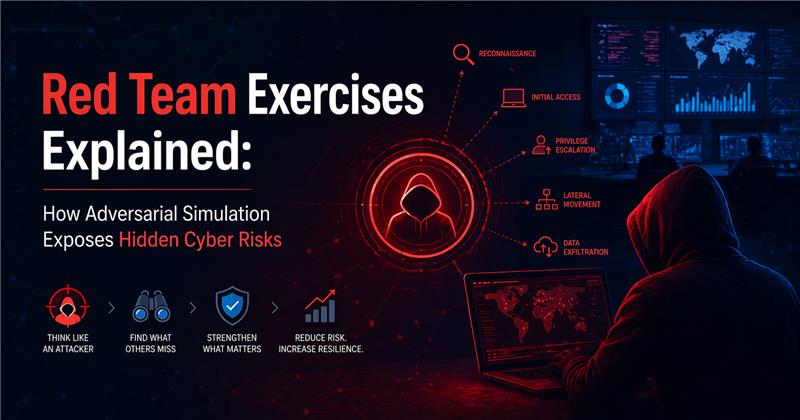
Security controls may look strong in dashboards, reports, and audit checklists. But the real question is whether they hold up against a determined attacker. A well-executed red team exercise helps organizations answer that question by simulating how real adversaries move, persist, evade, and target critical assets in the real world.
For ProTechmanize, red teaming is not just an offensive assessment. It is a business-aligned validation exercise that tests the combined effectiveness of people, processes, and technology across modern enterprise environments.
AT A GLANCE
- Red teaming goes beyond standard testing by measuring detection, response, and resilience under realistic attack conditions.
- A mature program combines expert-led red team engagements with ongoing monitoring, incident response readiness, and continuous validation.
- ProTechmanize brings together Red Teaming, MDR, Threat Intelligence, and AI-led security operations to help organizations move from assumptions to measurable confidence.
What Is a Red Team Exercise?
A red team exercise is a controlled, objective-driven simulation of a real-world cyberattack. Unlike a routine vulnerability assessment or a one-time penetration test, red teaming is designed to evaluate how attackers could actually achieve mission outcomes such as accessing sensitive data, bypassing security controls, moving laterally, or reaching crown-jewel systems.
At ProTechmanize, red teaming is positioned as a full-scope, multi-layered attack simulation that validates organizational readiness against modern threats. It examines how security tools perform, how teams respond under pressure, and where hidden exposure remains despite existing investments.
Why Red Teaming Matters More Now
Attackers do not follow audit boundaries.
They chain together reconnaissance, social engineering, credential abuse, malware delivery, privilege escalation, and persistence until they reach business impact.
Security gaps are often operational, not just technical.
Organizations may have controls in place, but alert triage, tuning, escalation discipline, and cross-team coordination can still break under real pressure.
Leadership needs proof, not assumptions.
Red teaming provides evidence of whether detection, containment, and response mechanisms can stand up to sophisticated adversary behavior.
This is also why red teaming works best when supported by Threat Intelligence & Monitoring, Managed Detection and Response, and AI-led SOC operations so findings can be translated into faster detection, stronger playbooks, and measurable resilience.
What a Modern Red Team Engagement Should Include
- Business-led scoping: The exercise should begin with clear objectives tied to critical assets, risk scenarios, and operational constraints.
- Adversary-realistic execution: The red team should emulate the tactics, techniques, and procedures that real attackers use across digital, human, and process layers.
- Stealth and response measurement: The goal is not only to break in, but to see whether your detection stack and response teams identify and contain the activity in time.
- Actionable reporting: Deliverables should highlight attack paths, control gaps, missed detections, response delays, and prioritized remediation guidance.
- Retesting and validation: Remediation is only complete when improved controls are tested again and proven effective.
Where Red Teaming Fits in a Broader Validation Strategy
| Approach | Primary goal | Typical cadence | Best fit |
|---|---|---|---|
| VAPT / penetration testing | Find technical vulnerabilities and exploitable weaknesses. | Periodic | Focused control testing and point-in-time assurance. |
| Red teaming | Test whether realistic attackers can achieve meaningful objectives and remain undetected. | Planned engagements | Measuring detection, response, and resilience across people, process, and technology. |
| Continuous validation | Re-test defenses regularly as environments, controls, and threats change. | Continuous / scheduled | Ongoing assurance using BAS, CART, and exposure-led workflows integrated with operations. |
How ProTechmanize Makes Red Teaming Operationally Useful
ProTechmanize's value is not limited to executing an adversarial simulation. The larger outcome is to convert findings into improved cyber defense operations. That means linking red team insights to security monitoring, incident response, governance priorities, and executive decision-making.
Because ProTechmanize operates across assessment, implementation, support, and governance, organizations can use red teaming outputs to improve security posture, refine escalation paths, tune detections, close process gaps, and strengthen resilience across critical business functions.
Relevant ProTechmanize capabilities that strengthen this lifecycle include Red Teaming, MDR, Threat Intelligence & Monitoring, and AISOC for organizations that want continuous visibility and faster incident response around high-risk exposure areas.
From One-Time Exercise to Continuous Assurance
A standalone red team engagement is valuable, but the strongest programs use it as part of a broader security validation strategy. Findings from one exercise should inform detection engineering, update incident playbooks, improve team readiness, and trigger follow-on testing.
That is where ProTechmanize's services-led approach becomes especially relevant. A business can begin with a red team engagement, operationalize the results through MDR or AISOC, and then extend continuous validation through Aquila I-driven BAS, CART, or CTEM workflows where appropriate.
The result is a more mature program: one that not only discovers hidden risk, but continuously measures whether defenses are improving over time.
Book a consultation
Hi! We'd love
to hear from you
Discuss your red teaming objectives, validate your response readiness, and align security testing to real business risk.
Contact Us