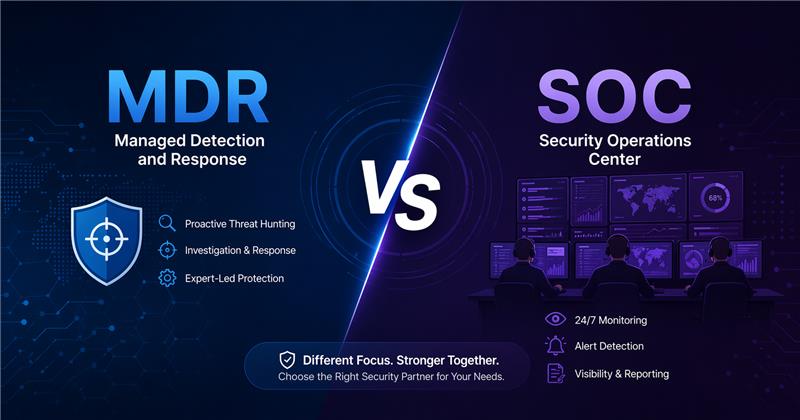
Why the MDR vs SOC decision matters
Managed detection and response and security operations center models both aim to improve visibility, accelerate threat detection, and strengthen incident response. The real difference is not whether one is “good” and the other is “bad.” The difference is how security is staffed, operated, escalated, measured, and improved over time.
For fast-growing organizations, the decision often comes down to operational reality: Do you need a provider to actively detect and respond on your behalf, or do you need a broader security operations function that gives you centralized visibility, reporting, governance, and sustained program ownership?
What is MDR?
Managed Detection and Response is a service-led model designed to detect, investigate, and contain threats quickly. It combines 24/7 monitoring, detection technology, human-led analysis, threat hunting, and guided or active response. MDR is usually the better choice when an organization wants rapid security outcomes without building a large in-house team.
At ProTechmanize MDR, organizations get 24/7 monitoring, AI-driven threat intelligence, proactive threat hunting, rapid incident response, and coverage across endpoints, cloud, and network environments. This model is built for teams that want outcomes, speed, and expert support without the overhead of standing up a full internal security operation.
- Best for organizations that need fast deployment and immediate improvement in detection and response.
- Useful when internal security teams are lean, overstretched, or still maturing.
- Works well when reducing alert fatigue and improving response speed are near-term priorities.
- Helps organizations access enterprise-grade expertise without the cost of building an in-house 24/7 team.
What is SOC?
A Security Operations Center is the centralized function responsible for monitoring, triaging, analyzing, and coordinating security events across the organization. A SOC can be fully in-house, co-managed, or consumed as a service. It typically brings together telemetry, SIEM, log management, investigation workflows, reporting, governance, and escalation processes in one operating model.
With ProTechmanize SOC as a Service, businesses gain round-the-clock monitoring, SIEM and log analysis, incident handling, and proactive cyber defense without the cost and complexity of building every capability from scratch. SOC is especially valuable when leadership needs broader visibility, auditability, and a structured security operations program that scales over time.
- Best for organizations that need centralized visibility across multiple systems, teams, and business units.
- Useful when governance, reporting, compliance evidence, and long-term operational structure matter deeply.
- Makes sense when there is enough internal ownership to coordinate tooling, workflows, and remediation across the business.
- Can be shaped into a managed, co-managed, or highly customized model depending on security maturity.
MDR vs SOC: side-by-side comparison
| Decision Area | MDR | SOC |
|---|---|---|
| Primary goal | Rapid detection, investigation, and active response | Centralized security operations, visibility, analysis, and governance |
| Ownership model | More provider-led and action-oriented | More programmatic and operationally structured |
| Time to value | Usually faster to deploy and operationalize | Can take longer depending on scope, workflows, and integrations |
| Internal staffing need | Lower day-to-day lift for the customer | Higher need for coordination, ownership, and process maturity |
| Response execution | Often includes guided or active containment | May escalate to internal teams depending on model |
| Visibility and reporting | Strong threat-focused visibility | Broader enterprise-level reporting and oversight |
| Compliance readiness | Supports control improvement and response maturity | Stronger fit for audit trails, log retention, and governance-heavy environments |
| Ideal fit | Lean teams, fast scaling businesses, outcome-focused buyers | Complex environments, regulated sectors, organizations needing deeper oversight |
When MDR is usually the better choice
- You need security coverage quickly and cannot wait months to design, staff, and tune a mature operations model.
- Your team wants expert analysts to investigate alerts, hunt threats, and help contain incidents before they spread.
- You are struggling with alert overload, ransomware readiness, phishing risk, or a lack of specialized security talent.
- You want a predictable service model that improves protection without major hiring and tooling expansion.
This is why MDR is often the right starting point for mid-sized enterprises, fast-growth companies, and teams that want measurable protection gains in the near term.
When SOC is usually the better choice
- You need a broader operating function that supports log analysis, incident workflow management, reporting, and long-term program governance.
- Your environment is complex, multi-cloud, heavily integrated, or spread across several business units and geographies.
- Leadership requires stronger oversight, compliance mapping, security metrics, and evidence that can support audits and executive reporting.
- You are building a mature security program and want centralized control over detection engineering, investigations, and operational workflows.
SOC is particularly powerful for organizations that view security operations as a strategic business function rather than only an incident response capability.
Why many organizations choose a hybrid path
In practice, the smartest choice is often not MDR or SOC. It is MDR plus SOC-aligned operations. MDR can handle frontline detection, threat hunting, and fast response, while SOC capabilities provide centralized visibility, governance, reporting, and coordination. This hybrid model gives security leaders both speed and control.
That is where ProTechmanize can add real value. Businesses can combine MDR, SOC as a Service, Red Teaming, and Phishing Simulation into a more complete resilience model that is easier to operationalize and easier to explain to leadership.
How to choose the right model for your business
- If speed is your top priority, start with MDR.
- If visibility, governance, and compliance are your top priorities, lead with SOC.
- If you operate in a complex or regulated environment, consider a hybrid model from day one.
- If you want a future-facing story for security transformation, connect the operating model to Aquila I and CTEM.
The best decision is the one that matches your internal capacity, threat profile, budget model, and leadership expectations. A model that looks strong on paper but does not fit your operating reality will create friction instead of resilience.
Final recommendation
For most organizations, the decision should not be framed as a technology comparison alone. It should be framed as an operating model decision. MDR is typically the faster route to protection. SOC is typically the stronger route to centralized oversight. Together, when designed well, they create a security program that is more responsive, more measurable, and easier to scale.
If your team is evaluating which path to take, ProTechmanize can help map your current maturity, operational gaps, and response needs to the right service model.
Book a consultation
Hi! We'd love
to hear from you
Discuss whether MDR, SOC, or a hybrid model is the right fit for your business.
Contact Us